
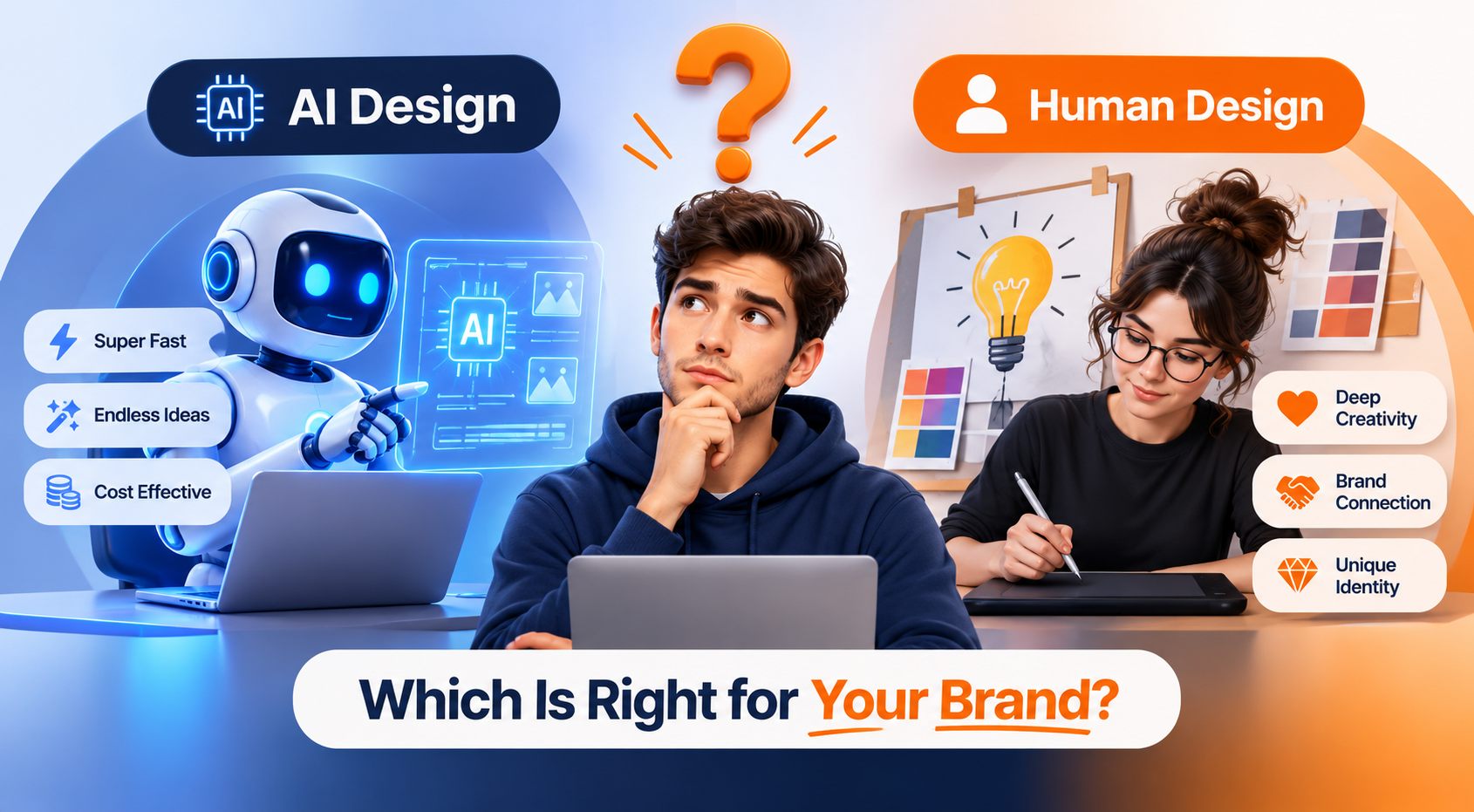
AI Design vs Human Design: Which Is Right for Your Brand?
AI design is fast and cheap. Human design builds a brand people remember. See where each wins and how to combine them.
AI Design vs Human Design: Which Is Right for Your Brand?
Use AI design for quick drafts, social posts, and low-risk visuals. Use a human designer for your logo, brand identity, website, and anything customers will connect with your name. For most businesses, the best result comes from combining both.
A few years ago, “design” meant hiring someone. Now you can type a sentence into a tool and get a logo, a banner, or a full landing page in under a minute. So it’s fair to ask whether you still need a designer at all.
We work with businesses on websites, logos, and graphics every week, so this question comes up constantly. Here’s an honest answer, including where AI actually helps.
What is AI design?
AI design means using software that generates visuals from a text prompt or a few settings. Think image generators, automatic layout tools, and website builders that assemble a page for you.
These tools learn patterns from huge collections of existing images and layouts. That’s why they’re quick, and also why their output often feels familiar.
What is human design?
Human design is work done by a trained designer who starts with questions, not a blank prompt box. Who is the customer? What should they feel? What makes this business different from the three competitors next to it?
The visuals come after those answers. That order is the real difference.
AI design vs human design: side-by-side
Factor | AI design | Human design |
|---|---|---|
Where AI design works well
Be fair to the tools. They’re good at several things.
Brainstorming. Need ten directions for a campaign mood board? AI gets you there in minutes.
Repetitive work. Resizing one banner into eight formats is boring, and a machine can do it.
Early drafts. Showing a rough idea to a client or teammate is easier with a visual than a paragraph.
Small, short-lived content. A one-day social post doesn’t need a brand workshop.
Where AI design falls short
It looks like everyone else. These tools learn from existing work, so results often feel familiar. A logo that resembles ten others won’t help you stand out.
It doesn’t know your customer. A designer picks up on who you’re selling to and what they care about. A tool only follows the prompt.
Ownership can get messy. Even the companies that build these tools are careful here. Adobe’sFirefly FAQ says the laws around generative AI are evolving quickly in every jurisdiction, and anyone with copyright questions should talk to a legal professional in their own region. Confirm who owns the final file before you build your brand on it.
Accessibility gets missed. Colour contrast, readable text, and clear navigation matter to visitors and to search engines. WordPress’saccessibility coding standards say code in WordPress core, WordPress.org sites, and official plugins is expected to meet WCAG 2.2 at level AA. Generated layouts rarely reach that level without manual fixes.
Where human designers win
Brand identity. A logo is a decision about how your business wants to be seen, not just a shape.
Websites. Good web design guides people toward an action. That takes an understanding of layout, copy, speed, and user behaviour working together. If that’s your goal, ourwebsite design services start with the business goal before any colour is chosen.
Original ideas. A person can make an unexpected connection. A tool mostly remixes what already exists.
Accountability. When something’s wrong, a designer fixes it and explains why.
The hybrid approach most businesses should use
This isn’t an either/or choice. A workflow that works well looks like this:
A human defines the strategy: audience, tone, goals, and what to avoid.
AI helps explore: mood boards, rough layouts, and variations.
A human chooses and refines: picks the strongest direction and rebuilds it properly.
A human checks the details: accessibility, file quality, ownership, and brand fit.
AI handles the repetitive output: resizing and formatting across channels.
So which should you choose?
Choose AI design when:
The content is temporary or low-risk
You need many quick variations
You’re exploring ideas before spending real budget
Choose a human designer when:
It represents your brand long-term (logo, website, packaging)
You need something no competitor can copy
Customers will judge your credibility by how it looks
You need clear ownership of the final files
If you’re starting a brand from scratch, begin with the identity. Ourlogo design service is built around that first step, because everything else you create will lean on it.
Final thoughts
AI design is a useful tool, and ignoring it would be a mistake. But a brand is built on being recognisable and trusted, and that comes from choices a person makes on purpose.
If you want help deciding where AI fits in your business and where it doesn’t,talk to the Sortiq Solutions team. We’ll tell you plainly which parts you can do yourself.