
What Is MERN Stack Development? Is It Right for You?
MERN stack development explained without the jargon: what MongoDB, Express, React and Node do, real project examples, and when MERN is worth choosing.
Sooner or later, if you’re planning a web app, a developer will say “we’ll build it in MERN” and move on as if everyone knows what that means. Most founders just nod. I’d rather you didn’t. So here’s the plain version. No buzzwords, no lecture. By the end you should know what MERN stack development actually is, what people build with it, and whether it suits what you have in mind.
So, what is MERN?
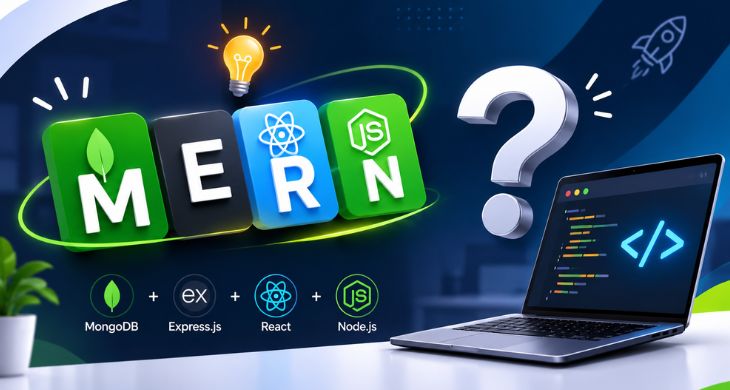
MERN is four tools that work as a team: MongoDB, Express.js, React and Node.js. The one thing they share is that they all run on JavaScript.
That sounds like a small detail, but it matters. Because it’s one language from the screen to the database, a developer can work on both sides of the app without switching mental gears. Fewer handovers usually means fewer misunderstandings, and fewer misunderstandings mean fewer late-night “why is this broken” messages.
The four pieces, using a restaurant
Think of your app as a restaurant. It’s not perfect, but it sticks in the mind.
MongoDB is the storeroom. Everything your app needs to remember lives here: customer accounts, orders, bookings, messages. What makes MongoDB friendly is that it doesn’t force your data into rigid tables. If you decide halfway through the project that users also need a “preferred language” field, you can add it without tearing things apart.
Express.js is the waiter. It carries requests from the customer to the kitchen and brings the answer back. When someone taps “My orders”, Express is what takes that request and sends it to the right place.
React is the dining room. It’s everything your visitors see and click: the pages, the buttons, the dashboard. React is good at making an app feel quick, because it updates only the part of the screen that changed instead of reloading the whole page. If the front end is your main worry, ourReact JS development page shows how we approach it.
Node.js is the kitchen. This is where the real work happens: checking logins, calculating prices, sending confirmation emails, handling payments. Node copes well when lots of people use the app at the same time. You can see more about the server side on our Node JS development page.
Put together, a single click goes like this. The customer taps a button in React, the request reaches Express, Node runs the logic, MongoDB hands over the data, and React shows the result. It takes a fraction of a second.
What do people actually build with it?
Let me use a few examples instead of a long list.
Say you run a coaching academy and want students to log in, watch lessons, take quizzes and download certificates. That’s a learning platform, and MERN handles it comfortably.
Or you own a salon chain and customers keep calling to book slots. A booking app with live availability, reminders and an admin panel fits the stack well.
Maybe you’re a startup with a SaaS idea, something like a small invoicing tool or a project tracker. You need to launch a first version fast, see what users do, and change things often. MongoDB’s flexibility helps a lot here.Other common ones: custom e-commerce stores, customer portals, internal CRMs that replace messy spreadsheets, and anything with chat or live notifications.
Why teams like it
The honest reasons, in order of how often they come up:
- One language across the project keeps things simpler.
- Changing your data structure later isn’t painful.
- React gives you an interface that feels like software, not a brochure.
- It scales reasonably well if the app is built with care.
- The community is huge, so finding help, tools and developers is easy.
- It’s a good way to get an MVP out quickly and improve it after real users show up.
When MERN is probably the wrong call
This part matters more than the sales pitch, so I’ll be straight about it.
If you just need a company website with a few pages and a blog, MERN is overkill. You’d pay for custom engineering you don’t need. A CMS is usually a better deal, and our WordPress development team can set that up far faster.
If your data is deeply connected and strict, like accounting or inventory systems with lots of linked records, a traditional relational database may serve you better than MongoDB.
And if your team already knows PHP well, a framework like Laravel might make more sense for maintenance later. We have a Laravel development service for exactly that comparison.
The stack should follow the project. Not the other way round.
A quick gut check
Answer these in your head:
Is it an application rather than a simple website? Will people log in and do things? Do you expect features to change in the next year? Do you want room to grow?
If most answers are yes, MERN deserves a serious look.
Talking to a team about it
Picking the technology is the easy bit. What decides whether a project goes well is everything around it: planning, clean code, security, testing and someone who sticks around after launch.
That’s the part we care about at Sortiq Solutions. Our MERN stack development service covers the whole journey, from the first sketch to support after go-live.
If you’re unsure whether MERN fits your idea,send us a short description. We’ll tell you what we’d use, even if it turns out not to be MERN.
Frequently Asked Questions
1. What does MERN stand for?
MongoDB, Express.js, React and Node.js.
2. Is it good for small businesses?
Yes, if you need a custom app. If you only need a simple website, there are cheaper options.
3. Can MERN apps handle a lot of users?
They can, provided the architecture is planned properly. Poorly built apps struggle on any stack.
4. How long does a MERN project take?
A basic MVP can take a few weeks. Bigger platforms take months. A proper estimate needs a look at your requirements.
5. What’s the difference between MERN and MEAN?
MEAN uses Angular for the front end. MERN uses React. Everything else is the same.